Part 1: The Beginning of a History
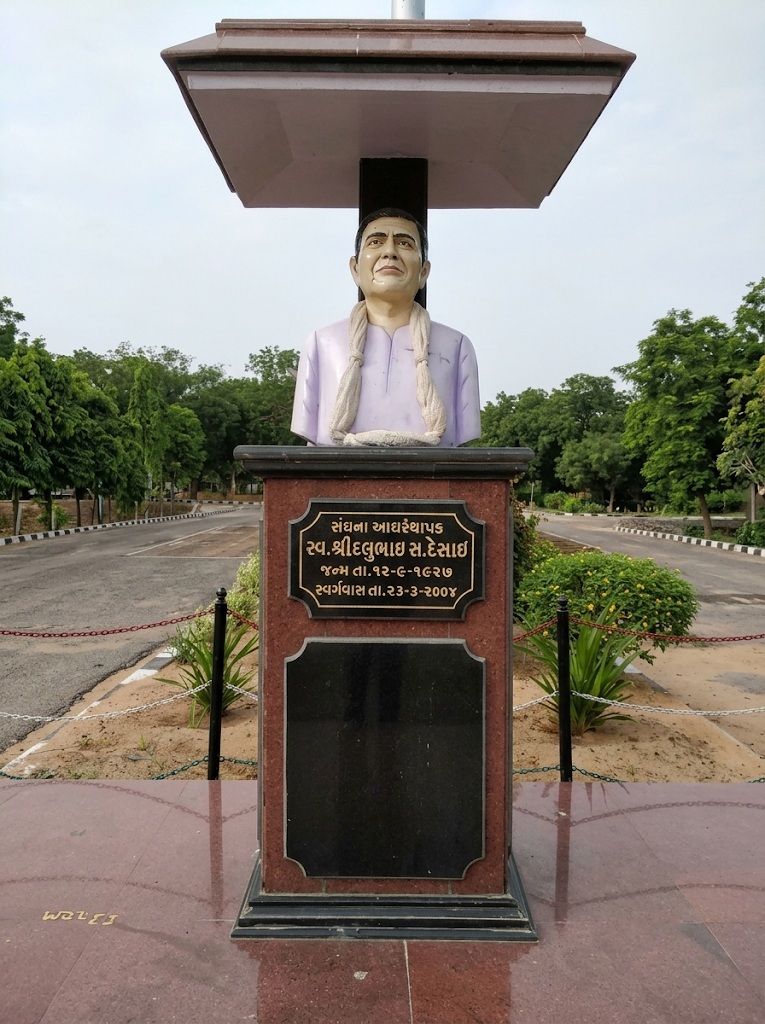
Dalubhai Desai means a godfather, a political reformer, a social worker, and a revolutionary yet ascetic politician. The credit for turning the social and political equations of Banaskantha district by 180 degrees in the last three decades of the twentieth century goes to Dalubhai Savjibhai Desai. Known by popular and affectionate names like DS Desai and 'Dalubha', Dalubhai Desai was born on September 12, 1927, in Jagana village of Banaskantha district.
Banaskantha is the northernmost district of Gujarat state, sharing one border with Rajasthan and another with Pakistan. Divided into east and west by the flow of the Banas river, Banaskantha district lived with the label of a backward district until the 1960s. More than 30 percent of the total population of this district belonged to the Chaudhary caste. But the condition of the Chaudharys was pitiful. They were not only uneducated and backward, but also exploited by other developed classes of society. The Chaudhary community of eastern Banaskantha was extremely poor, uneducated, and plagued by addictions and evil customs. Some Chaudharys were like landlords, but the lack of education was clearly visible in them too. Due to this, despite having a one-third majority, they had no dominance in the district. The district's politics was largely in the hands of the leading castes, while western Banaskantha was dominated by strongmen. It is said that the tyranny of these strongmen in western Banaskantha was so much that before going to irrigate their own fields, Chaudharys had to go and irrigate the fields of those strongmen. It is said that even if a Chaudhary went to a fair, he would hide his identity as a Chaudhary to escape their oppression.
At such a juncture in history, a boy born into the Desai clan of Chaudharys in Jagana village of eastern Banaskantha emerged as a lawyer. He was one of the early individuals from the district's Chaudhary community to come forward after receiving higher education. His name was Dalubhai Desai. Having risen from a poor family through sheer hard work, Dalubhai gradually saved money and bought an office in Palanpur city.
It was the year 1964 and Dalubhai was 34 years old. At that time, some Chaudharys from western Banaskantha came to Dalubhai with a case. One of their brothers had gone to protest against some strongmen teasing a Chaudhary girl and was killed by them. Now those Chaudharys wanted Dalubhai to fight the case and get those elements punished. But Dalubhai refused to take their case. He said, "I am not sitting here to fight the cases of cowards. Are you Chaudharys or who are you? Do not come to me crying like this. Go, first fight against the injustice with all your might. And if you face any legal trouble in doing so, I am sitting here."
The Chaudharys from the west heard such encouraging words for the first time. So now they got into a direct conflict with the Rajputs. Because of this, two cases of Chaudharys trapped in the violence against those strongmen came to Dalubhai, and Dalubhai saved them from punishments like hanging and life imprisonment, limiting their sentence to two to five years in jail. Thus, two things happened. The Chaudharys gained the courage to struggle against exploitation and injustice, and on the other hand, Dalubhai's legal practice started booming. Dalubhai began to emerge as a clever and powerful personality in the Chaudhary community.
Now, during this period, the idealistic Chaudhary leader Galbabhai Nanjibhai Chaudhary, known as the 'Gandhi of Banas', came in contact with Dalubhai. The whole district knew Galbabhai as 'Galbakaka'. Galbakaka was the main Chaudhary leader in Banaskantha. But his identity was not that of a Chaudhary leader, but of a Gandhian leader fighting for the poor, exploited, and downtrodden classes. Despite being very less educated, at that time Galbakaka had gone to Denmark to study the dairy industry and had established the Banas Dairy upon returning. He had also been an MLA. When he came in contact with Dalubhai, he was the President of the Banaskantha District Panchayat. In Dalubhai, he saw a skilled politician and a courageous social worker. Galbakaka reached Dalubhai's office near Kirtistambh in Palanpur and said, "Now I am getting old. I have not studied much, whereas the rival leaders and the officers working at their behest are well-educated. Until today, I managed to run things somehow with my innate wisdom, but now it is difficult. Everyday new conspiracies are hatched to remove the only Chaudhary leader like me from the path. You are educated and intelligent. You will be able to handle them. I will get you a ticket. Now you take charge from here onwards."
For Dalubhai, these words were no less than a blessing, but he was not ready for it. He said, "It has only been eight years since I started my practice. I have four children who are still studying. I have risen from extreme poverty and have barely managed to stabilize. I still want to earn money and strengthen my foundation." But Galbakaka did not give up his stubbornness. He said, "You just consider that along with those four children, this society is also your child. And if you can bear to see the sorrow of the fifth child while providing happiness to those four children, then don't listen to me. But speaking from my life, the life lived for society is the true life. So before you make a decision, take a look at the condition of the Chaudharys in this district."
In this way, Galbakaka finally convinced Dalubhai to become a secretary of the education committee in the district panchayat. As the district secretary, Dalubhai always stayed with the district president, Galbakaka. Here, Dalubhai thwarted the conspiracies of rival leaders and the Collector against Galbakaka twice. Galbakaka now knew that Dalubhai was a rare genius possessing a balance of extraordinary intellect and immense empathy.
Now, Galbakaka started his final efforts to step aside and establish Dalubhai. He started lobbying in the Congress so that Dalubhai could get the assembly ticket. Dalubhai described this period many times later in his own words: "I saw Galbakaka pressing the thighs and knees of those Congress stalwarts in front of me many times. He was making only one demand, 'You look at me once and give a ticket to this boy. I assure you that he will not disappoint you.' Many times my inner self-respect would fume and I would blurt out, 'Kaka, stop. Don't do all this for me. I cannot watch it anymore.' But he would tell me, 'I am doing this not for you, but for this society. Today I am pressing their thighs, tomorrow he will press yours.'"
Remembering these words of Galbakaka, Dalubhai would often get emotional and say, "I was still in a dilemma regarding the decision to join politics. But when I saw Galbakaka doing all that, I understood how many expectations he had pinned on me. Even today, when I remember that picture, I sit up from my sleep and start checking what else can be done for this society by me. Is anything still being left out?"
Finally, Galbakaka's hard work paid off, and Dalubhai got the assembly ticket for Dhanera taluka from the Congress. With his unprecedented public contact and oratory skills, Dalubhai won that 1972 assembly election securing 55 percent of the votes. Thus, in 1972, at the age of 42, he became the MLA of Dhanera, and with this victory, he wrapped up his booming eight-year practice as a lawyer. Handing over his office as a successor to a promising twenty-six-year-old boy named M. L. Chaudhary who was preparing under him, he stepped out of the world of legal practice, never to return to it again. His journey thereafter in politics kept pushing him from one service to another. Even today, M. L. Chaudhary runs his practice as the best criminal lawyer of North Gujarat from that very office of Dalubhai near Kirtistambh.
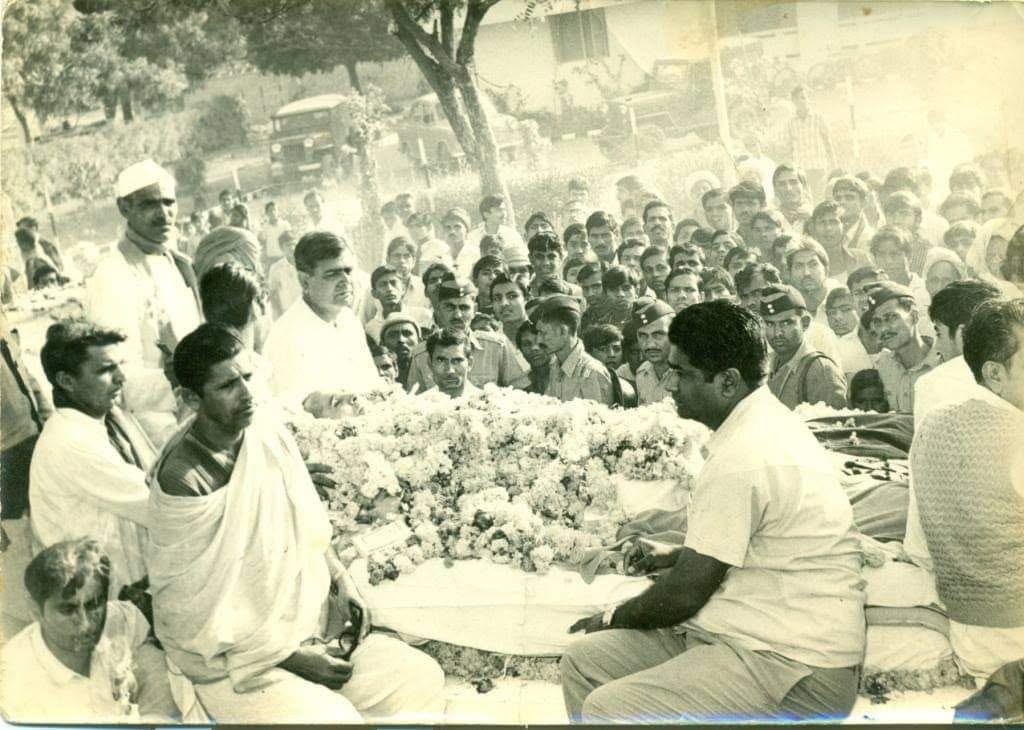
As soon as Dalubhai became an MLA in 1972, Galbakaka retired from politics, and the very next year in 1973, Galbakaka died suddenly due to a penicillin injection reaction. When Galbakaka's funeral procession went from Palanpur to his village Nalasar, Dalubhai sat near the head of the mortal remains of his political guru throughout the journey. After Galbakaka's demise, the responsibility of Galbakaka's legacy in Banaskantha politics fell on the shoulders of the 47-year-old Dalubhai. And from here emerged the godfather Dalubhai Desai, who had his own principles and an autocratic empire of his own, built on those principles and dedicated to the ideals of social service. Dalubhai's rise was the dawn of an era that fundamentally overturned the social and political history of Banaskantha.
Part 2: The Rise of an Empire
After becoming an MLA, Dalubhai Desai's simplicity caught people's attention. Dalubhai would walk a kilometer from his house in Jagana every day to reach the highway, catch a bus to Gandhinagar, and reach the assembly sitting on the MLA's seat in the bus. His experience as an MLA was barely a year old when in 1973, Chimanbhai Patel split the Congress, overthrew Ghanshyam Oza's government, and became the Chief Minister himself. Despite Chimanbhai's efforts, Dalubhai did not go with him and remained in the Congress. And Chimanbhai got an opportunity to take revenge for this very soon.
At that time, Dalubhai, along with some of his Bania (merchant) friends, had started a mustard (Rayda) mill, whose affairs were managed by Dalubhai's eldest son, Narsinhbhai. One night, a watchman of that mill committed suicide inside the mill after a quarrel with his wife. As soon as this news reached Chimanbhai, he seized the opportunity. With the help of Dalubhai's local opponents, he framed Dalubhai's eldest son in the watchman's murder case. Many proofs and witnesses were altered, and Dalubhai's son had to go to jail. Dalubhai understood whose doing this was. He told a close leader of Chimanbhai, "I considered Chimanbhai to be a clever man, but he turned out to be a coward. He went ahead and framed an innocent boy? Tell him that if Chimanbhai has the guts, this Dalubhai is sitting right here, let him do whatever he wants to do to me. But do not drag innocent boys into politics. Politics also has some principles."
When these words reached Chimanbhai, he called Dalubhai to meet him at the Chief Minister's office. In this meeting, Chimanbhai was highly impressed by Dalubhai's personality and placed a condition for a compromise. The condition was simply that Dalubhai should accept Chimanbhai as his lifelong friend, and his son would return home. Dalubhai was not one to compromise with his principles, but in Chimanbhai, he saw a powerful leader possessing unfathomable innate wisdom hidden behind a rebel leader. And thus began a deep friendship between Dalubhai Desai and Chief Minister Chimanbhai Patel, which remained intact until their deaths. Within a week, on the basis of the post-mortem report, Dalubhai's son was acquitted and returned home.
A few months after this incident, on February 9, 1974, Chimanbhai had to resign from the Chief Minister's post due to the Nav Nirman movement, and elections were announced again. However, this time, Dalubhai refused to contest the assembly elections. For him, eradicating the fundamental problems of Banaskantha district was the primary goal, and there was no other work as an MLA than raising a finger in the assembly. At that time, the President of the District Panchayat had more power than an MLA. He was considered the head of the district, and the power to decide which direction to take the district largely remained in the hands of the District Panchayat President. This was exactly what Dalubhai wanted. Therefore, skipping the assembly elections this time, he fought the district panchayat elections and became the President of the District Panchayat after winning.
Dalubhai's victory in the district panchayat elections marked the end of Brahmin dominance in the district's politics. Dalubhai realized this. Therefore, in his two-and-a-half decades of political life, he ensured that no injustice was ever done to Brahmins. He was always ready to do the work of Brahmins, and because of this, Dalubhai enjoyed good popularity among them. Later on, he once gave up his own designated assembly candidacy from Dhanera to promote a Brahmin candidate. On the other hand, for the poor, exploited, and downtrodden classes of the district, Dalubhai as the district president was not just a new face but also a new hope. He started by bringing political awareness among the poor. He was aware of the tyranny of certain classes in the western district. There was only one way to tame that tyranny: to increase the political participation of the exploited class. The majority in this exploited class was of Chaudharys. Therefore, Dalubhai started bringing the handful of educated Chaudharys from western Banaskantha into politics. In this way, he brought youths named Joitabhai Patel from Dhanera, and Jagtabhai as well as Parbatbhai Patel from Tharad into politics by making them leave their government jobs. From Kankrej taluka, he joined Mafabhai Desai from the Rabari community into politics. Initially, Dalubhai made these new leaders win taluka panchayat elections and made them taluka presidents. Jagtabhai, who remained the president of the taluka panchayat in Tharad, served continuously for twenty years. Now, Dalubhai got assembly tickets for Joitabhai from Dhanera and Parbatbhai from Tharad, making them MLAs of their respective talukas.
But all this was not so easy. When Parbatbhai Patel was fighting his first assembly election from Tharad, strongmen practically put entire constituencies under house arrest. They would threaten and force anyone who came out of the house to vote back inside. When Dalubhai, sitting in Palanpur, came to know about this, he personally reached Tharad with a large contingent of police forces and deployed the police in the constituencies. The tyrannical elements who came to oppose them were booked on the spot by filing police complaints and were imprisoned. By evening, 142 such police cases were registered, and voting continued. Dalubhai himself went from door to door, brought people out of their houses, and made them vote. In this way, Parbatbhai Patel won his first assembly election and became the MLA of Tharad.
But recalling an incident even before this event, Parbatbhai says, "I used to work in a bank. One evening, Dalubhai's phone came to the bank. He told me, 'Stay in the bank today. Do not go home at night.' I obeyed his words without knowing any reason. At six in the evening, I heard the news on the radio that I had been given the assembly ticket from Tharad. The next morning when I went home, I found out that at night, some strongmen armed with weapons had come to my house to threaten me. Dalubhai kept me in the bank because the only armed security guard was at the bank. His concern and planning to raise new leaders of the society were so meticulous."
In this way, the new leaders groomed by Dalubhai started reaching the pinnacle in every taluka of Banaskantha. On the other hand, Dalubhai and the leaders prepared by him continued the work of constantly bringing up other new leaders from those backward classes, and he filled the lower positions with those new leaders. Thus, with the entire politics of the district coming into the hands of Chaudharys and other exploited classes, the dominance of other strongmen ended.
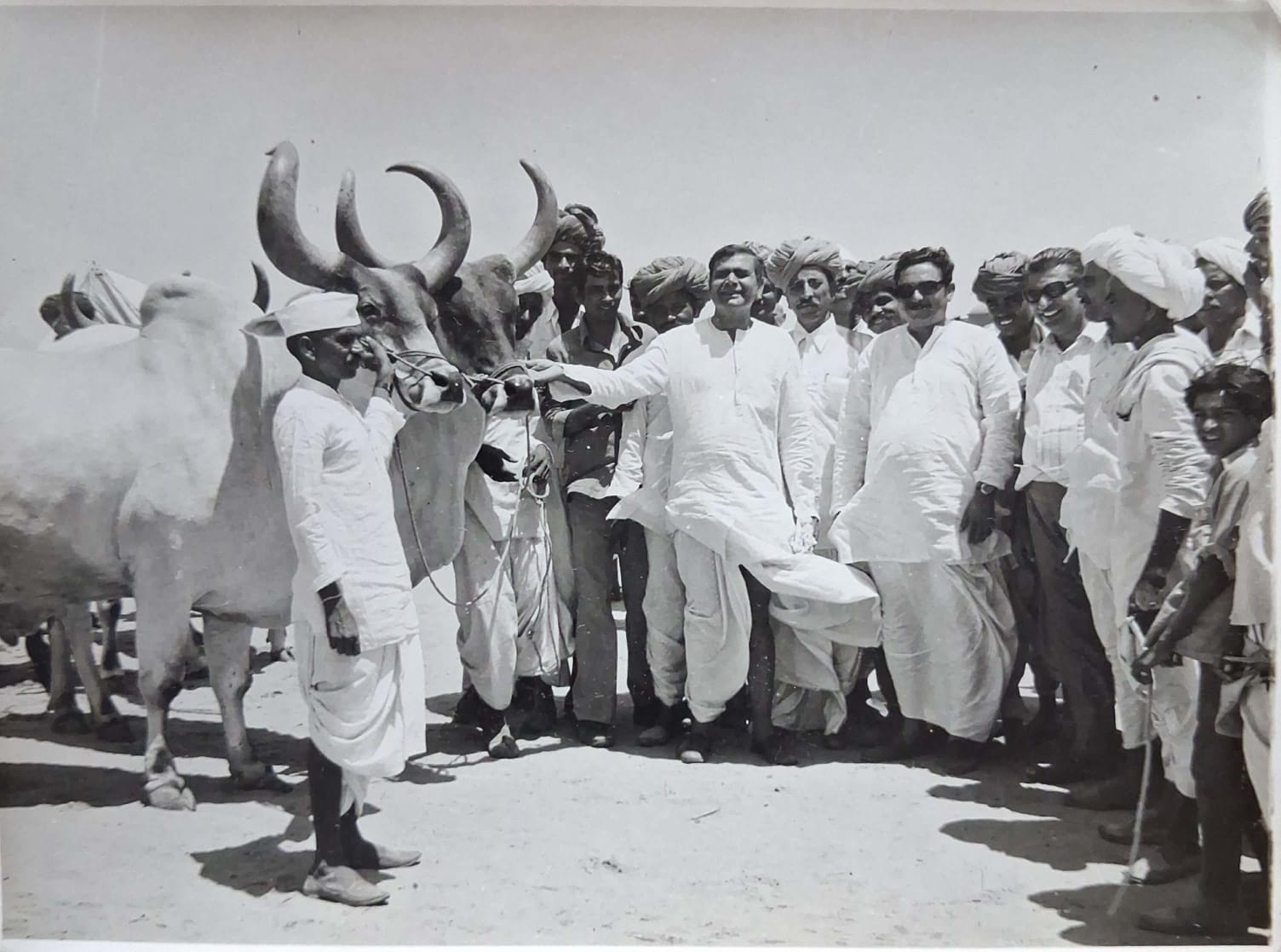
Now, Dalubhai proactively called the Rajput leaders and said, "As the president of this district, I am like a father to all of you, and you are all my children. But how can a father tolerate one son oppressing another? There must be balance in the public. The right to achieve development and become prosperous should be given equally to everyone. So now, this right has to be given first to those who have been exploited till today." In this way, Dalubhai removed the animosity between the Rajputs and other classes and gave the Rajputs a place in the politics of taluka panchayats and the district panchayat according to their population. This was the highest form of Dalubhai Desai's politics. Despite having the support of the majority population of the entire district, he never let the district's political equations tilt to any one side. Like an equanimous king, he always maintained a balance among all classes of society. It was for this balance that he once withdrew the assembly ticket from Dhanera meant for himself, made a Brahmin leader the candidate in his place, and got him to win. Due to this very reason, Dalubhai's popularity started growing among all classes of the district.
This was the time when Dalubhai was becoming like a messiah for the backward and exploited classes of the district. The majority of the district's population was under Dalubhai's control, and now they had gained so much power that not a single leaf of the district's politics could move against their will. The leaders of the exploited classes were fairly established as MLAs, but to gain unchallenged, dictatorial power over the district, Dalubhai needed to seat his own man as a Member of Parliament as well. He himself did not want to leave his grip on the district's ground. So it was necessary for him to survive on the ground as the district president. Hence, to send his man to Delhi, Dalubhai prepared B.K. Gadhvi from a minority community. B.K. was Dalubhai's friend from his law practice days. Dalubhai presented B.K. as his associate by making him the secretary of the education committee in the district panchayat. To bring B.K. forward, Dalubhai even started getting B.K. Gadhvi's name written alongside his own in the invitation cards addressed to him. Apart from this, he started sending B.K. Gadhvi as his representative to attend certain programs. In this way, he brought B.K. into direct contact with the people across the district. B.K. Gadhvi's eloquence added further interest to this plan.
Finally, when election time came, he got B.K. Gadhvi a Congress ticket through Chimanbhai. Chimanbhai tried hard to convince Dalubhai that this could prove to be a mistake and that Dalubhai should take the ticket himself and enter Delhi politics. But many schemes for the development of the district were still revolving in Dalubhai's mind. So, he called upon all the people of the district to make B.K. Gadhvi win, and on his one command, the district gave B.K. Gadhvi a massive victory. B.K. Gadhvi reached the parliament in Delhi as a representative of Dalubhai. In this way, Dalubhai took the entire politics of Banaskantha district under his control. This was the time when who would become the MLA in every taluka of the district and who would become the district's MP was all decided solely by Dalubhai Desai.
This was the era of Godfather Dalubhai Desai when, if a central minister came to Banaskantha, or if they had to go present an issue before the Collector or the Governor, Dalubhai remained at the forefront as the main leader at every place for their welcome, and behind him would be all the MLAs and the MP of the district as his followers. Once, when Prime Minister Indira Gandhi landed at Deesa airport, she was welcomed by the district's MP and MLAs as per protocol. But as soon as the formalities were over, Indira Gandhi immediately asked, "Who is Dalubhai Desai?" Dalubhai was immediately called there. Indira Gandhi asked Dalubhai to sit in the helicopter with her and discussed the social and political needs of the district en route from Deesa to Palanpur.
This was the golden age of Dalubhai Desai's political career. In this golden age, he prepared stalwarts of today and yesteryears like Joitabhai Patel, Parbatbhai Patel, Nathabhai Patel, Kalubhai Tarak, Jagtabhai, Mafabhai Desai, Bhemabhai Patel, Mavjibhai Patel, Dalsangbhai Chaudhary, and B.K. Gadhvi for the bright future of Banaskantha. He did not keep these leaders prepared by him as rubber stamps like today's leaders. He created the qualities of a responsible politician towards the public in those young leaders. The reason for taking everyone along with him to welcome a minister or for discussions with the governor was not to flaunt his own power and authority. By keeping those young leaders with him in this manner, he was training them to develop high leadership capabilities. Dalubhai would often sit his disciple-like leaders to eat with him and, while eating, he would teach them all the nuances - how to take decisions in the public interest, how to prepare the public mind for those decisions, how to speak with the senior leaders of the party, how to behave. Among all these leaders, preparing B.K. Gadhvi proved to be his biggest mistake going forward, and preparing politicians ruling over the public mind like Joitabhai Patel proved to be an invaluable gift from him.
But this was not the end of Dalubhai Desai's empire. So far, he had turned the political equations of the district by 180 degrees, and now it was time to change the social conditions of the district, which was his original goal. This golden age was the maximum powerful state of Dalubhai's empire, from where he started taking those revolutionary steps that gave birth to a new political ideology named Dalubhai Desai. Those revolutionary decisions of Dalubhai Desai, which entirely changed the fundamental lives of the poor and backward people, are in the third part of his story.
Part 3: Social Revolution and the End of Political Life
Once, Amarsinh Chaudhary called Chief Minister Chimanbhai Patel and expressed his desire to contest elections from Danta in Banaskantha. Chimanbhai gave him Dalubhai's number and asked him to talk to him. Amarsinh Chaudhary called three times a day for two days, but Dalubhai did not answer the phone. Angered, Amarsinh called Chimanbhai again and said, 'Does this Dalubhai consider himself the Chief Minister? He hasn't picked up the phone for two days.' Chimanbhai replied, 'You must have called at the wrong times. Call between ten to one in the morning and six to eight in the evening, and he will pick up. And yes, you said it right. Dalubhai Desai is the Chief Minister of Banaskantha. Remember this while talking to him.'
So, this was the state's Chief Minister's assessment of Dalubhai. With this kind of authority, Dalubhai now initiated a social revolution in the district.
Historic Campaign for Jobs for the Poor
He started mass recruitment of poor and exploited people in every government, cooperative, and private structure of the district. Much of this recruitment was through underground channels. In every government and panchayati raj office, from the district panchayat and taluka panchayats to the gram panchayats, countless poor people were given jobs as peons, helpers, clerks, gram sevaks (village workers), and talatis without regarding their educational qualifications. In his own village of Jagana, he gave one government job per household, whether that household belonged to a Chaudhary, Brahmin, Prajapati, Suthar, Panchal, Dalit, or sanitation worker community - one person per household from every class was given a job.
How intense Dalubhai's campaign to give jobs to the poor was can be estimated from this one example. Once, an elderly Dalit man came to the district panchayat with some problem and was standing and crying in front of an officer. At that moment, Dalubhai came out of his cabin and saw the old man pleading. Dalubhai went to him and inquired about the problem. He was sick, and there was no one else at home to earn. Beside him stood his young son of twenty or twenty-two years. Dalubhai asked the boy, 'How much have you studied, boy?' 'I passed the tenth grade, sir,' the boy replied. Dalubhai told his officer, 'Join those two tables opposite into one table; the brother sitting there has a heavy workload. Separate one table from there, place a chair opposite it, make this boy sit there, and teach him half of that brother's work.'
This was exactly how Dalubhai was giving jobs to the poor. Voices of opposition were often raised against his method. But every time, he silenced those opposing voices with his arguments. He would say, 'It has only been thirty years since this country became independent, and this country is full of poor and uneducated people. If you insist right from now that only those with high educational qualifications should get jobs, then all those jobs will go only to the affluent class. So, do you want to see the future generations of these poor people begging as well? They too are humans. Teach them the work, and they will learn. They know how to read and write, which is enough. Let their homes run with these jobs, and let their children study so that tomorrow their children can come to you holding the degrees you want.'
It is very difficult to say how many people Dalubhai must have given jobs to. But the people who witnessed that time estimate the number to be above two thousand. However, it is necessary to mention here that more than half of the jobs he gave were given to Chaudharys. And because of this, he was often accused of being communal.
An inquiry was set up against Dalubhai here, and a team of IAS officers came from Gandhinagar for the inquiry. Dalubhai showed them the list and said, 'Look, here are Jua, Judal, Karen, Kunia, Patel, Parmar, Jegoda, Mor, Popat - do you see a single Chaudhary in this? All these complaints are politically motivated.' For those IAS officers who came from Gandhinagar, it was difficult to even imagine that all these were surnames of a single caste. Names with the Chaudhary surname were only two to three percent. The officers closed the inquiry, went back, and declared the allegations against Dalubhai baseless. Apart from this, Dalubhai also left behind a waiting list for the recruitment of Gram Sevaks and Talatis, in which there were a large number of Chaudharys and people from backward classes. That list only opened long after Dalubhai's retirement from politics, and at that time, many Chaudharys and backward class people who had reached their forties and were farming became Talatis and Gram Sevaks overnight.
Dalubhai always had arguments ready to justify even these caste-based decisions. He used to say, 'The leaders of affluent castes in the past did exactly this and kept a very large section of society backward. Just as poison cures poison, the social imbalance created by political casteism can initially only be destroyed by the casteism of the exploited class. Till today, any poor and needy person who came to me, I helped them without looking at their caste. But Chaudharys constitute more than 30 percent of the population of this district. And if uplifting one caste can bring up 30 percent of society's poor simultaneously, then doing that work first is true practicality. Moreover, I am a Chaudhary myself, so I understand their situation and problems much better. The people of this entire district are equal to me. But the massive task of bringing equality to society has to be done in parts, and the upliftment of the Chaudharys is the biggest part of this massive task.'
As proof that these words were not hollow lip service, even today in the district panchayat, Banas Dairy, and other government offices, one can find many people from non-Chaudhary castes who carry Dalubhai Desai's photo in their wallets, because years ago, it was Dalubhai who gave them a job and provided a means of livelihood. Even today, there are many homes in western Banaskantha where Dalubhai's photo is placed alongside the photos of gods, and incense sticks are lit before him daily. This is a factual reality. Once, when Dalubhai was asked, 'Despite doing so much for this district, why don't you get a memorial built for yourself?', Dalubhai replied, "When this society is filled with the thousands of people I gave jobs to and their doctor and engineer children, then consider that educated and prosperous society itself as my memorial."
“When this society is filled with the thousands of people I gave jobs to and their doctor and engineer children, then consider that educated and prosperous society itself as my memorial.”— Dalubhai Savjibhai Desai
District Development Works and Political Conflict
Apart from the mass recruitment of the poor, Dalubhai paid attention to many other issues of public interest. Since a large part of western Banaskantha was adjacent to the Rann of Kutch, it was a dry and saline region. The people here were not yet destined to get pure, sweet drinking water, and no previous leaders had done anything about it. Dalubhai initiated efforts for this and laid a long pipeline supplying pure drinking water from eastern Banaskantha to the farthest regions of western Banaskantha, which even today supplies drinking water to the people of western Banaskantha. Along with this, to ensure irrigation water reached the western district, he obtained permission from the Chief Minister and started the work on a canal. But knowing that if those uneducated farmers of the west got canal water for irrigation, their prosperity would increase and their own businesses would shut down, the merchants of the western district instigated those farmers. They told the farmers that if this canal came here, the government would take away your land for the canal, and you would end up on the streets. Those misguided farmers staged a protest by stringing a garland of shoes when Dalubhai went there to address a gathering. An angered Dalubhai said, 'You deserve only this,' left from there, and stopped the canal work. That unfinished work from that time was completed thirty years later just recently by MLA Shankarbhai Chaudhary, who brought the canal there.
During this same period of history, the fierce selflessness of Dalubhai's personality also came to the fore. When Morarji Desai's Janata Dal government came to power in 1977, the Congress presidents sitting below in the district panchayats began to be harassed. Their schemes and the grants coming for them were stopped. Because of this, hurdles began to appear in many schemes initiated by Dalubhai for the people of the district, such as the water pipeline. Therefore, so that there is no hindrance in the works of public welfare and the initiated schemes could be completed successfully, Dalubhai defected and moved from Congress to the Janata Dal. When the Janata Dal lost in 1980 and Indira Gandhi formed the government again, Dalubhai returned to Congress. This decision of Dalubhai is considered his biggest political mistake.
This mistake hurt him in this way. As we discussed earlier, Dalubha made B.K. Gadhvi a Member of Parliament and sent him to Delhi. But after reaching Delhi, B.K. Gadhvi established relations with big leaders like Madhavrao Scindia and Gujarat's Madhavsinh Solanki, and even became the country's Minister of State for Finance. Therefore, B.K. Gadhvi's lobby at the upper level in the Congress became strong. Now he did not need Dalubhai to get a ticket. But the district's public was in Dalubhai's hands, so B.K. Gadhvi also started preparing his own leaders against Dalubhai's leaders at the local level and succeeded in it. On the other hand, due to his defection, Dalubhai's image was tarnished in Delhi, and B.K. Gadhvi's credibility increased. Therefore, in 1980, '84, and '89, all three times, the Congress ticket for Banaskantha's Member of Parliament went to B.K. Gadhvi, out of which he won the elections in '80 and '84. But in the 1989 Lok Sabha elections, the Janata Dal ticket against B.K. Gadhvi went to J.V. Shah. To bring B.K. under control, Dalubhai asked the people of the district to vote for J.V. Shah. As a result, per Dalubhai's wish, B.K. Gadhvi lost, and J.V. Shah became the Member of Parliament in the Janata Dal government. But J.V. Shah, like B.K. Gadhvi, also tried to dismantle Dalubhai's empire as soon as he reached the top.
Thus, the decision to defect, even if for public welfare works, cost Dalubhai heavily politically. Today, when leaders scramble to get a Member of Parliament ticket by taking advantage of their caste's majority, Dalubhai always gave up that ticket designated in his name to serve that caste and the entire society. Today, when leaders defect from one party to another simply because they did not get a ticket from one party, Dalubhai had harmed his own personal reputation in the party by defecting so that there would be no disruption in public welfare works. This was the selflessness of Dalubhai Desai.
Once, Chimanbhai had said, "I always wanted to see a great leader like Dalubhai on the national stage. But I could never tame the selflessness and ascetic mindset residing within him. Whenever I told him to fight the Lok Sabha this time, he would say that he had no money to fight elections. I would say I will send the money, and he would dismiss the matter by saying, 'If I lose, your money will drown.' For a man on whose word the district's MLAs and MPs were elected to talk like this was a mystery to me. Later on, I understood that in reality, that man is a saint in the guise of a politician. An ascetic who has come disguised as a leader to do something, and having finished it, wants to go back home as soon as possible."
“Later on, I understood that in reality, that man is a saint in the guise of a politician. An ascetic who has come disguised as a leader to do something, and having finished it, wants to go back home as soon as possible.”— Chimanbhai Patel, Former Chief Minister of Gujarat
The Revival of Banas Dairy
Now returning to the time immediately after defecting back to Congress, where in 1982 a new task fell on Dalubhai's head. The Banas Dairy started by Galbakaka sank into debt due to the mismanagement of Galbakaka's successor. The dairy had no profits, but just to say the dairy is running, a monthly profit of a thousand rupees—equal to a peon's salary—was being shown. Finally, the second chairman resigned, and it was time for the dairy to close. At that time, the livelihood of many poor people and widows in the district depended on animal husbandry. Therefore, the farmers and cattle rearers of the district came to Dalubhai as a last resort and requested him to find some solution. Dalubhai accepted becoming the chairman of the sinking dairy on the condition that he would make decisions like a dictator and no decision of his would be opposed. The cattle rearers accepted that condition, and Dalubhai became the third chairman of Banas Dairy.
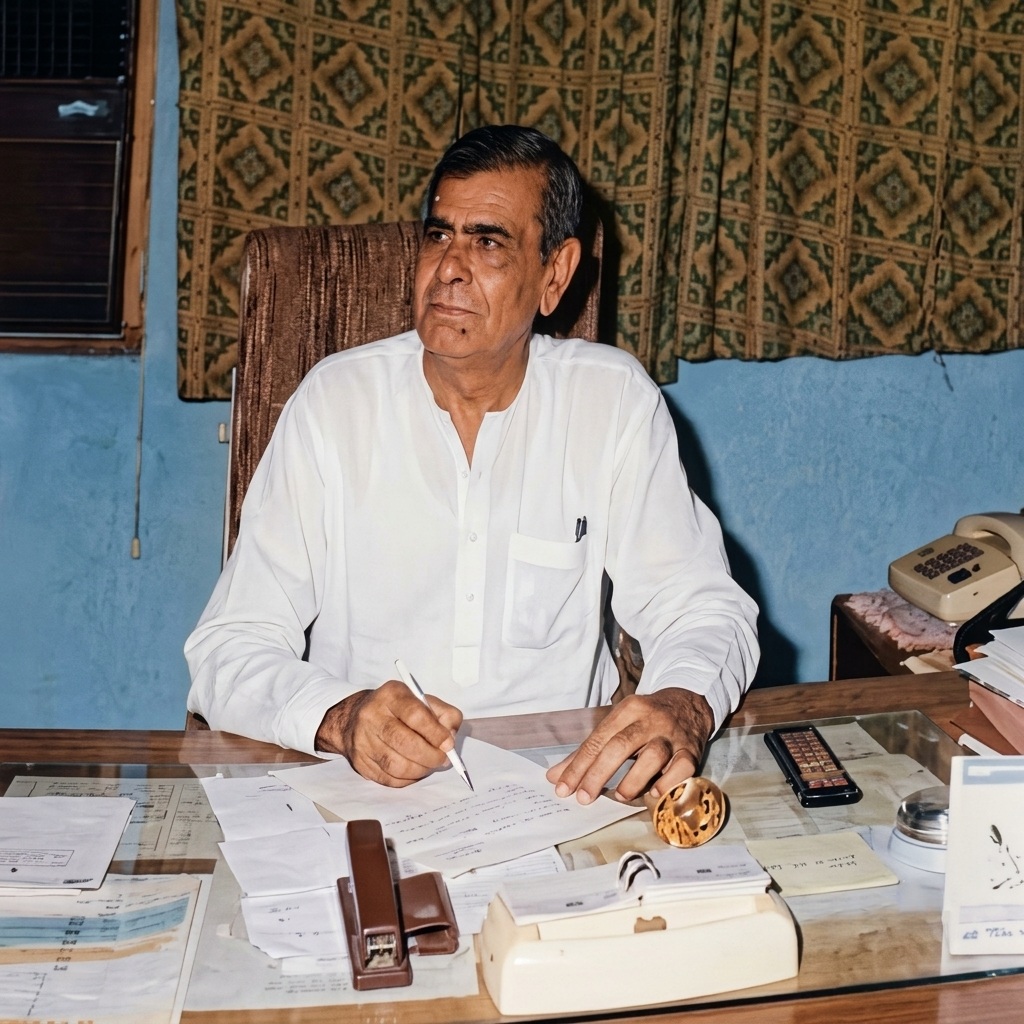
He asked the chairman of the district cooperative bank to approve a loan of one crore rupees in the name of Banas Dairy. The chairman hesitated to sanction such a large loan. Dalubhai said, "Today is Friday. By next Friday, either approve the loan, or a new chairman will be sitting here who will approve it." Ultimately, when that chairman did not budge, Dalubhai used his political clout to force the cooperative bank's chairman to resign, had J. V. Shah appointed as the new chairman of the Banas Central Bank, and got the one-crore loan sanctioned in the dairy's name. With that capital, he paid off the dairy's debt, procured new machinery, fired corrupt people from the old staff, and recruited new people he trusted into the dairy. He kept the dairy's administration away from any active politics. He organized the process of procuring, storing, processing, and packaging milk into a well-structured system. He ran awareness and incentive programs about animal husbandry from village to village, due to which milk collection in the dairy started increasing. By 1991, the dairy's milk collection reached 50,000 liters a day. Thus, Dalubhai not only saved Banas Dairy from sinking but turned it into a highly profitable and successful institution.
In 1991, when Dalubhai felt that his work was done, he called a meeting of the dairy's directors, announced his resignation, and installed Parthibhai Bhatol, who was serving as a director, as the new chairman of the dairy. Parthibhai was not ready for that responsibility at the time. He wanted to push forward his construction business. But Dalubhai convinced him in the exact same way Galbakaka had convinced Dalubhai to leave his law practice. Thus, when he felt his responsibility was fulfilled, he voluntarily placed the leader from Vadgam taluka as his successor, carving the path to carry forward Galbakaka's legacy.
Not only that, Dalubhai also took Parthibhai to Delhi along with Joitabhai and Parbatbhai, introduced all three to Balram Jakhar, and said, 'I am on the verge of retirement now. But you have to give tickets to these three boys as my successors.' Dalubhai voluntarily left every post as soon as his work was complete and never tried to install anyone from his own family as his successor. Parthibhai Bhatol remained the chairman of Banas Dairy for 24 years and made Banas Dairy the largest dairy in Asia, collecting more than 40 lakh liters of milk a day. Parthibhai openly stated in his speeches multiple times, 'If Dalubhai exists, this dairy survives. If Dalubhai had not been there, this dairy would not exist either.' As long as Dalubhai lived, even though he held no post, he always ensured that politics did not enter the dairy.
Political Dominance and Foresight
During his tenure as the dairy's chairman and thereafter, Dalubhai also served as a director of the Gujarat Electricity Board. This was the beginning of the 1990s. With the Ram Mandir issue, the BJP was rising in the country and in Gujarat. The BJP was looking for leaders in Gujarat. At that time, a prominent BJP leader, Keshubhai Patel, came to Dalubhai's house to meet him. Keshubhai urged Dalubhai to join the BJP and said that Dalubhai would be the biggest face of the BJP not just in Banaskantha but in the whole of North Gujarat. All candidates for the Lok Sabha, Rajya Sabha, and Vidhan Sabha would be decided solely by Dalubhai.
But Dalubhai gave two reasons and refused Keshubhai. He said, 'Keshubhai, first of all, your saffron ideology will not suit me. It is possible your policies expand in the future and you succeed. But I cannot associate myself with this negative saffronism of yours today. And anyway, people have not yet fully understood my previous defection, and I don't want to prove their allegations right by defecting a second time.'
Despite rejecting Keshubhai's offer, on a personal level, Dalubhai and Keshubhai's relations remained friendly. Later on, when Shankersinh Vaghela was contesting elections from Radhanpur, the BJP was considering giving the ticket to a newcomer local leader, Shankarbhai Chaudhary, against him. But before making that decision, Keshubhai called Dalubhai to ask whether his party was doing the right thing. It was Dalubhai who said, 'The decision is absolutely correct. That boy will not win but will give Shankersinh a tough fight, and you will get a future leader. Give the ticket to him only.'
Why Keshubhai would call Dalubhai and why Chimanbhai respected him so much is important to understand here. Dalubhai's strong grip on the Chaudhary community spread from Banaskantha to Mehsana, Patan, Sabarkantha, and Kheda. Chimanbhai took full advantage of Dalubhai to get votes from all these districts, and Dalubhai used Chimanbhai for public welfare works. Dalubhai also had a deep affection for the Chaudhary-Patels of Sabarkantha, and Dalubhai had a fair amount of interference in their politics too. Today, the Punsari village of Sabarkantha, which is widely discussed as a prosperous village across the country—the politics of that village was handled by Dalubhai for years while sitting in Banaskantha. In the Punsari region, other castes were in the majority compared to the Chaudhary-Patels. But every time, Dalubhai would poke something from the top through the big shots of the party in such a way that the Congress ticket for the village Sarpanch went only to Natubhai, and relying on the Congress vote bank, he became the Sarpanch every time. For almost two decades, Dalubhai helped Natubhai and his son become Sarpanch. And Dalubhai's trust in them proved right. Natubhai and his descendants made Punsari's development a model for all of India. The Himanshubhai Patel we see today as the Sarpanch of Punsari on various TV programs is the grandson of that very Natubhai. In this way, Dalubhai's political capability extended far from Banaskantha, but he rarely thought of leaving the soil of Banaskantha and its people to go further. Even in the national leadership of the Congress, Dalubhai's relations with former Lok Sabha Speaker Balram Jakhar remained as close as with Chimanbhai.
The Gift of OBC Reservation and the Mustard Refinery
The 1990s marked the twilight of Dalubhai’s political life, yet even in this final phase, society received two major gifts from Dalubhai Desai. Until then, Dalubhai had given the Chaudhary community jobs and leaders, but the Chaudhary community of Banaskantha remained just as backward in education. After V. P. Singh implemented the Mandal Commission in 1989, Haribhai of Charada village in Mehsana had been working to get the Chaudhary community included in the OBC category, but had not yet succeeded. Dalubhai then took up this cause as well. His close friend Chimanbhai Patel had once again become Chief Minister in the early 1990s. Dalubhai instructed Bhemabhai Patel—a leader he had groomed in Banaskantha—to launch a campaign from Banaskantha demanding OBC status for Chaudharis and to join forces with Haribhai of Charada. The Baxi Commission report was also in favor of granting reservation to Chaudharis; all that remained was getting the government to make the decision. For this, Dalubhai kept up steady pressure on Chimanbhai. Finally, he called Chimanbhai one day and said, "If you don't believe it, come here once. I will show you how Chaudharis are living." Chimanbhai replied, "I don't need to come there; you come here to Gandhinagar." It was 1994–95. When Dalubhai met Chimanbhai, Chimanbhai had already signed the document granting OBC reservation to the Chaudharis. Chimanbhai said, "Call your community together. We need to announce this." A few days later, Chaudhary community leaders from across the state were invited to Gandhinagar for a small ceremony to announce the reservation. Chimanbhai wanted to give full credit for the reservation to Dalubhai in front of everyone and make him the hero of the moment. However, as if reading Chimanbhai’s mind, Dalubhai deliberately left for Mumbai for a medical checkup on that very day. At the event, Chimanbhai asked the Chaudharis, "Where did that boss of yours go?" Today, the lion's share of credit for securing reservation for the Chaudharis goes to Haribhai of Charada—known as the Bhamashah of the community—and rightly so. Yet very few people know how Dalubhai worked behind the scenes. This was the side of Dalubhai that led Chimanbhai to call him "a saint in the guise of a politician."
And then came Dalubhai’s final gift to Banaskantha. Banaskantha was a leading district in mustard (rai) production. However, farmers had to go from place to place to small oil mills to sell their produce. These mills bought mustard from farmers, extracted the oil, and sold it back to those very farmers at high prices—and the quality of the oil was not even high. Now 68 years old and in poor health, Dalubhai decided to do something for the farmers here as well. He went to Anand and met Dr. Verghese Kurien. He presented to Dr. Kurien the idea of establishing a farmers' cooperative oil mill in Banaskantha and convinced him to provide financial assistance from the NDDB, which Dr. Kurien chaired. Dalubhai then met his friend Chimanbhai Patel, who was Chief Minister of Gujarat at the time (in 1993). Chimanbhai allotted his friend roughly fifty acres of land in Badarpura village of Banaskantha at a nominal rate of just one rupee per square foot. Thus, with financial support from the NDDB, Asia’s largest mustard oil refinery was built on that land and inaugurated in 1996. The oil mill was so massive that it had the capacity to produce five lakh tons of mustard oil per day. Dalubhai Desai became the chairman of the Badarpura mill as well as the Gujarat Cooperative Oilseeds Growers’ Federation (GROFED).
Political Retirement and Final Chapter
However, Dalubhai’s health began to deteriorate day by day. His prostate condition worsened, and he underwent three surgeries within a short span of time. During these days of his illness, a manager at the oil mill secretly sold off a tanker full of oil. Dalubhai’s opponents began trying to implicate him in the scandal. To protect the spotless reputation he had maintained his entire life, Dalubhai resigned from the chairmanship of the mill and GROFED, as well as from all positions in public and educational institutions. Around this time, Chimanbhai told Dalubhai, "Set your machinery in motion; this time you are going to the Lok Sabha." Dalubhai again asked, "What if I lose?" Chimanbhai replied, "Then I will send you to the Rajya Sabha, but you are not staying here anymore." By now, Dalubhai also felt he had done everything he could for the district, so he agreed to Chimanbhai’s wish. Perhaps fate, however, did not approve of his consent. Before the Lok Sabha elections arrived, Chimanbhai passed away while still in office as Chief Minister. For Dalubhai, this was a far greater personal blow than a political one. When the Lok Sabha elections came around, B. K. Gadhvi jumped into the race and spent two months in Delhi lobbying for the ticket. From Delhi, Balram Jakhar asked Dalubhai to come to Delhi and meet everyone. Dalubhai refused, saying, "What I am sitting right here is the real me. If I am to get the ticket, it should be on that basis alone." After Chimanbhai’s passing, his wife Urmilaben lobbied for Dalubhai. All the other Gujarat Congress Lok Sabha tickets were announced, but the suspense over the Banaskantha seat dragged on. Eventually, the Congress high command yielded to Madhavsinh Solanki’s threat to leave the party if B. K. Gadhvi was not given the ticket. B. K. Gadhvi was given the Banaskantha ticket, while Dalubhai was offered Sabarkantha. Dalubhai refused to contest from Sabarkantha. He resolved instead that whoever stood against B. K. Gadhvi, he would ensure their victory. Meanwhile, the BJP ticket for Banaskantha went to a new leader named Haribhai Chaudhary, who hailed from Dalubhai’s own village. Dalubhai reached out to all his contacts across the district, urging them to vote for Haribhai. He began mentoring Haribhai, often visiting his home even at midnight to guide him on what to say and what not to say in his morning speeches. During those days, Dalubhai made so many phone calls that his home landline bill came to sixteen thousand rupees. The combination of Dalubhai’s hard work, Atal Bihari Vajpayee’s name, and the BJP fielding its first Chaudhary candidate led to an easy victory for Haribhai. With B. K. Gadhvi’s final defeat and Haribhai’s victory, Dalubhai brought his two-and-a-half-decade-long journey of public-service politics to a permanent close. It was the end of a great era in Banaskantha’s politics. As a monument to that era, a statue of Dalubhai Desai was unveiled in the courtyard of the Badarpura Oil Mill a few years after his passing.
It is extremely important to mention here that despite this political friction with B. K. Gadhvi, the personal relationship between Dalubhai and B. K. Gadhvi always remained healthy and close. Whenever family difficulties arose, both stood by each other's side. The sight of those times was such that after delivering speeches against each other all day, Dalubhai and B. K. Gadhvi would sit in the same house and eat from the same plate. B. K. Gadhvi had publicly stated that he had never eaten from the same plate even with the uncle who raised him in his father's absence, yet he had shared a plate with Dalubhai many times. After Dalubhai retired from politics, when some attempts were made to harass his family over old political and personal grudges, it was B. K. Gadhvi who protected the family in Dalubhai's absence. In addition, Joitabhai Patel, advocate Masotbhai (M. L.) Chaudhary, Parbatbhai Patel, and Parathibhai Chaudhary also always made every possible effort to help Dalubhai's family. Among them, Joitabhai Patel and the late advocate M. L. Chaudhary are recognized as rare individuals who lived their lives in devoted gratitude toward Dalubhai.
What Dalubhai accomplished in the two and a half decades after Galbakaka secured him a ticket in 1972 was something even Galbakaka himself could not have imagined. The Chaudhary community of Banaskantha, once suppressed as an exploited class, now has two MLAs of its own in every taluka. Chaudhary leaders from Banaskantha today hold ministerial positions in both the state government and the Government of India. From the district dairy to the bank, all cooperative institutions are in the hands of Chaudharis. Today, the participation of Chaudharis in Banaskantha’s markets has grown manifold compared to the past. Banaskantha’s Chaudhary community now boasts over 100 doctors and surgeons. Over the past two decades, Chaudharis rank first across all of Gujarat among castes that have achieved maximum progress by utilizing OBC reservation. At the very core of this complete transformation of the Chaudhary community lies Dalubhai Desai’s two-and-a-half-decade-long unchallenged influence. Dalubhai Desai is the turning point that gave birth to the Banaskantha we see today.
The single seed named Dalubhai Desai that Galbakaka planted in the arid, backward soil of Banaskantha grew into a trunk that created a mighty tree laden with countless branches, blossoms, and fruits. Thus, if Galbakaka is the root of the Chaudhary community’s progress, Dalubha is the trunk of that tree—because for two and a half decades, every branch of Banaskantha’s politics emerged from him and ultimately converged back into him. Dalubha is called the Bhishma Pitamah of Banaskantha’s politics. Yet, looking at the partnership of Galbakaka and Dalubha together, one feels compelled to say that if Galbakaka is the "Gandhi of Banas," then Dalubha is the "Sardar of Banas." The difference between Galbakaka and Dalubha was the very same difference that existed between Gandhi and Sardar. Galbakaka was an idealistic Gandhi, whereas for Dalubha, Sardar’s pragmatism—establishing what is right at any cost—was the highest ideal.
Message for the New Generation and Family Ideals
In his final days, Dalubhai’s views on politics had shifted to some extent. In a speech during his last years, he said, "Now, this society does not need politicians. Now this society needs doctors, engineers, scientists, teachers, and great thinkers who step beyond the boundaries of this district and walk shoulder to shoulder with those at the pinnacle of the outside world. In a society of such thoughtful and broad-minded people, high ideals arise naturally. When such people return to this district, they will bring new ideas with them. And it is through those new ideas that the true welfare of this society will come." Through these words, Dalubhai meant that politicians only exploit a society’s narrow-mindedness for power, preventing it from rising above the divisions of casteism and regionalism. But if a society is filled with doctors, engineers, scientists, and great thinkers, then even politicians must adopt great ideas and ideals to govern such an enlightened society. Thus, only a great society can produce great leaders.
“Now, this society does not need politicians. Now this society needs doctors, engineers, scientists, teachers, and great thinkers... Only a great society can produce great leaders.”— Dalubhai Savjibhai Desai
Dalubhai’s vision can be seen flourishing in the lives of his own descendants. One of his grandsons became a computer engineer, worked for years as a manager in companies like IBM in Australia, and now runs a software and hardware startup in Sydney. Another grandson, an automobile engineer, serves as the Regional Manager for Tata Motors in Gujarat. Two of his granddaughters are also settled in Australia with their families. Another granddaughter is a homeopathic doctor, and her husband, an MBA graduate from IIM Ahmedabad, is among the top ten managers of Amazon in India. Dalubhai’s daughter’s son, Dr. Kaushik Chaudhary, is a dental surgeon as well as a well-known author, thinker, and advisor to think tanks—a recognized figure in Gujarat and across the country. His eldest granddaughter's daughter holds a PhD in Mathematics from M.S. University, Vadodara, and her mathematics papers have been published in prestigious research journals worldwide. She works as a professor at M.S. University itself. Both her younger brother and her husband are software engineers working at high salaries in multinational companies.
Simplicity, Spirituality, and Humanity
Now, finally, let's look at a few other facets of Dalubhai's personality beyond his political life. The first facet is his indifference toward financial prosperity. Even after occupying top political posts for such a long time, he did not bring a single wrongly earned penny of corruption into his house. After giving up his law practice, his household was run on savings and by farming his ancestral land. In the partnership in the mill he ran with his merchant friends, he only received a share enough to cover one person's expenses, and that too ended when the mill was shut down following the watchman's suicide incident. After entering politics, he met his personal expenses from the salary he received for the post he held, and he fully utilized the accommodation, food, and vehicle facilities provided by that post. Meanwhile, his household, consisting of four children and grandchildren, survived on his sons' salaries and farming. When he was the district president, his daughter once asked him for silver anklets (Sero) to wear, but it took Dalubhai three months to buy those anklets for his daughter.
During these simple times, he met a man who earned property for Dalubhai. Ramchandbhai Prajapati from Jagana, today a co-partner in Satyanam Private Company and a businessman in Palanpur, came into contact with Dalubhai at that time. In Ramchandbhai's own words, "One day, I was sitting alone with Dalubhai in his field. I said to him, 'Sir, until when will you make these boys farm and do jobs? Set up some factory or business for them. A big leader like you also has many enemies. If the family is not financially prosperous after you are gone, people will harass the boys.' Dalubhai told me, 'The field I am in is a work of service. If I want to earn money there, I would have to do wrong. And that is contrary not only to my ideals but also to my nature. My strength lasts only as long as I know I am right. The moment I prove false in my own eyes, my power vanishes.' Hearing these words from Dalubhai, I realized that this is no ordinary man. This is a divine soul whose power lies only in his divinity and purity. From that day on, I decided that I would handle the financial stability aspect for Dalubhai."
After this, wherever Ramchandbhai bought lands, he kept a half share for Dalubhai and invested Dalubhai's entire income from farming and animal husbandry into buying those lands. Ramchandbhai says that at one point, most of the land between Palanpur and Jagana belonged to both of us. But if Dalubha saw a little profit, he would sell the land without telling Ramchandbhai. So then Ramchandbhai would have to invest that money in another piece of land. In this way, through Ramchandbhai's business-mindedness, Dalubhai passed on a hundred and twenty-five bighas (approx. 50 acres) of land on both sides of the National Highway to his sons as an inheritance. It was as if God had sent a man like Ramchandbhai to a detached person like Dalubhai to provide him with financial prosperity.
Another hidden facet was his spirituality. Dalubhai's religiosity was full of contradictions. We mentioned that Dalubhai's political rise meant the end of Brahmin politics in the district. Dalubhai was aware of this. Therefore, in his two-and-a-half-decade political life, he ensured that Brahmins were never wronged. He was always ready to do the work of Brahmins, and because of this, Dalubhai enjoyed good popularity among them. But he was a staunch opponent of items and donations given to Brahmins at home during festivals or occasions. Not only that, when his young granddaughters went to the temple to observe Goro (a fast), each of them had to first show their puja plate to Dalubhai. Dalubhai would check to make sure they hadn't taken anything to give to the Brahmins. Moreover, he openly opposed blind superstitions. If someone had placed a coconut on the road to cast an evil spell while he was coming home, he would bring that coconut home and feed it to the children. Once, Dalubhai drove a tantrik away from his house, and the tantrik told Dalubhai, 'I will erect a trishul (trident) to destroy you.' Dalubhai replied, 'Good. I will come every day to pour water on that trishul of yours.' This fierce opposition to the hypocritical face of religion was the conclusion of his strong willpower and deep reflection on religion. Because on the other hand, he also had knowledge of how many Smritis and Samhitas there are in the Vedas. He possessed deep spiritual knowledge about the Gita, Vivekananda, and Osho, which he presented only in front of select people.
To what extent his actions and thoughts were filled with humanity can be lightly estimated from this one incident as well. In Dalubhai's own Desai neighborhood, there was another man whose name was also Dalubhai. That other Dalubhai was a common farmer and was always ready to oppose Dalubhai. Once, a police officer came to the original Dalubhai. In Dalubhai's time, the police never entered Jagana village. So the police officer parked his jeep outside the village and walked to Dalubhai. He told Dalubhai, 'Dalubhai, a Dalit has filed an atrocity case against you. Is there any other Dalubhai in the village?' Dalubhai understood that he himself had done nothing of the sort. This work was definitely the doing of that other Dalu, who was his staunch opponent. To save his opponent, Dalubhai told the policeman, 'Who else would be Dalubhai in this village other than me? Now that a case has been filed, here I sit. Take me, then.' The policeman didn't have that much courage. He quietly drank water and left from there.
So this was the biography of Dalubhai Desai - who, to save even a fiercely opposing opponent from going to jail, would tarnish his own great image in front of a policeman, and would never let that opponent even know about it. Those who stayed with Dalubhai their whole lives and observed him closely always say one thing: 'It is a question whether we will ever be able to fully understand the greatness of Dalubha or not.' Spreading the fragrance of such a rare personality across the world, on the early morning of March 23, 2004, Dalubhai breathed his last on the soil of Banaskantha.